Family History Classes
We offer genealogy classes throughout the year at varying times, both in-person and on Zoom.
Our classes cater to all ages and levels, from beginners to advanced researchers.
Intermediate Class Series
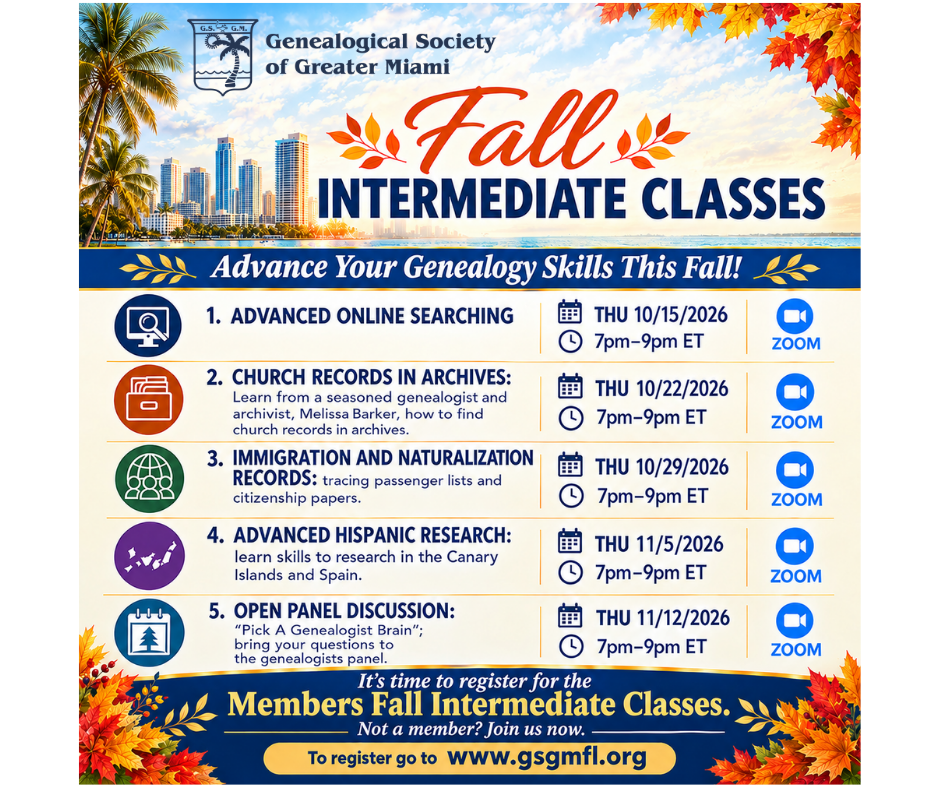
Begins Oct. 15, 2026
On Zoom
7-9pm
A Member Only Benefit
Socials and Other Events
Stay tuned for more information about upcoming events.
General Meetings are the 1st Saturday of the month from October through May.
Our upcoming Member Meeting will be held at 2:30pm October 3, 2026, followed by the general meeting/presenter
Past Presentations and Workshops
Did you miss it? Members can access video and documents related to our past events in the GSGM members’ section of the website. Not yet a member? Click Here to Join!
-
![]()
Cheryl Gowing of UM Libraries and the Scottish American Society of South Florida joined us at the Pinecrest Library and discussed how to get started searching for the records of your Scottish Ancestors - across the pond and in the States. Resources and links were shared to her favorite sites. Dinna Fash! You’ll be tracing family in no time.
-
![]()
Do you want to share your love of genealogy with the young people in your family? Get them excited about their history!
-
![]()
Sometimes family lore suggests you are descended from royalty or Mayflower passengers, but Tavernkeepers, you say? Debbie Duay will join us at the Pinecrest Library to discuss lineage and the various types of ancestors you may find in your tree!
-
![]()
Matthew Bunch of "This Day In Miami History Podcast" will join us at the Pinecrest branch library to discuss how he became interested in finding answers through history and genealogy, and what question he was asking that led to creating his podcast. How do you come up with the questions to conduct research when you didn't even know you had them?
-
![]()
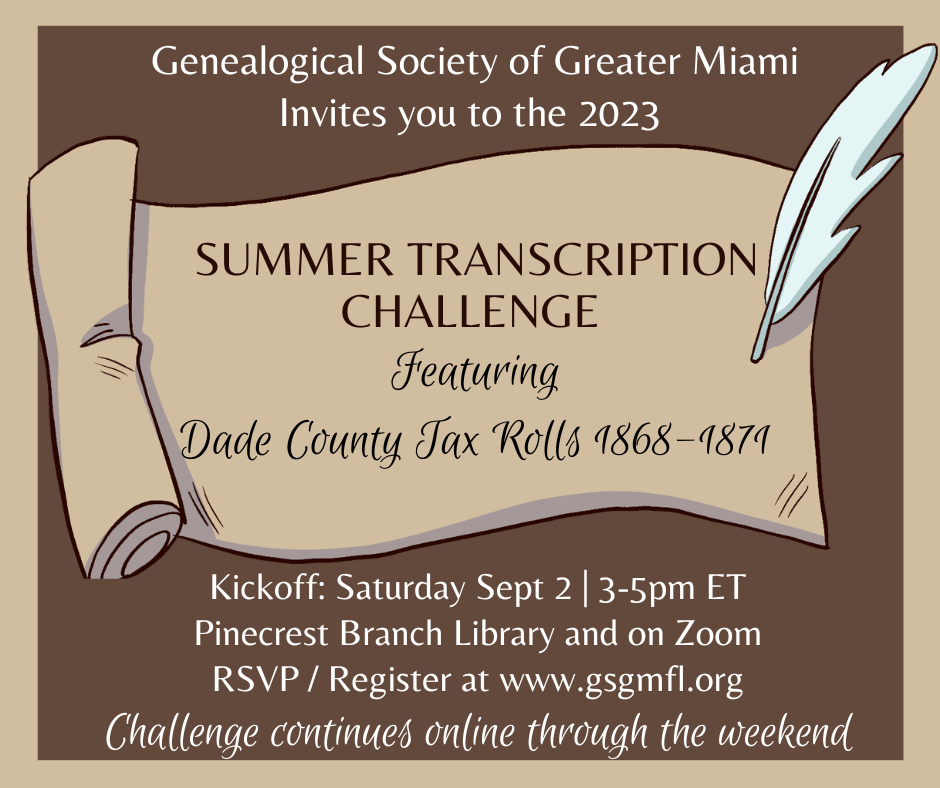
2023 - Dade County Tax Rolls Transcription Challenge Results
Approximately 75 hours and almost 600 indexed records have been contributed by volunteers, including training, to transcribe and/or review 60 pages from the original Dade County Tax Rolls from 1868-1885.
-
![]()
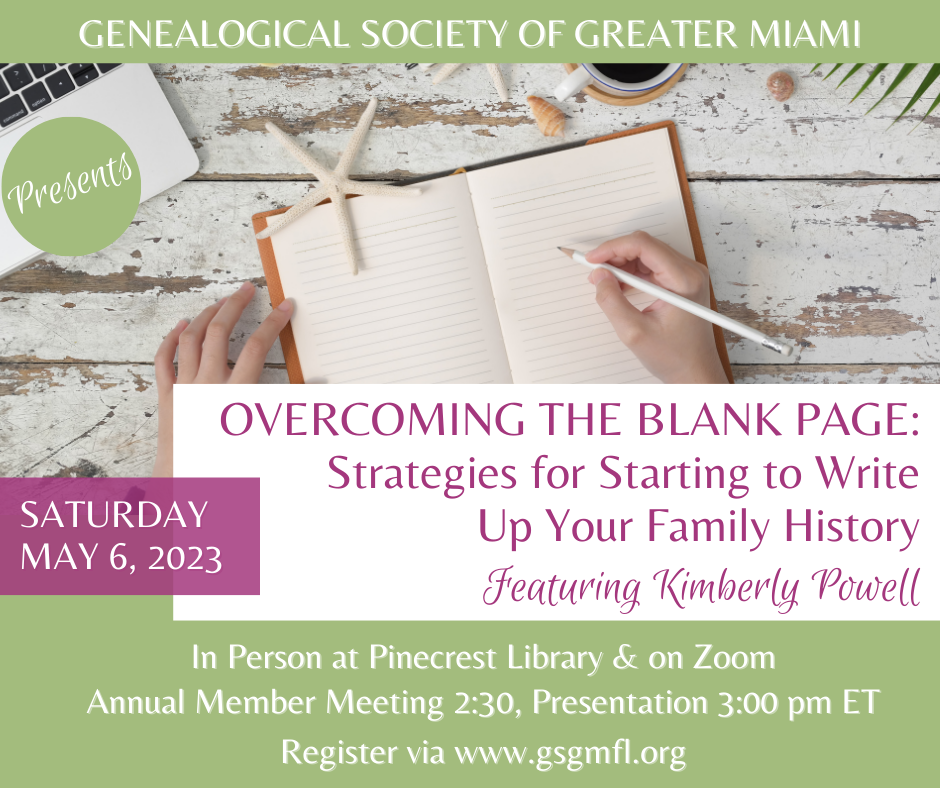
If you struggle with procrastination, perfectionism, or paralysis when you sit down to write up your hard-won family history research, this is the session for you! We'll explore why we need to keep good research notes, how to accomplish it without overwhelm, and strategies for getting from a blank page to the first rough draft.
-
![]()
Lisa Louise Cooke discussed a wide variety of rich resources are available for free through Google. Google’s empire includes a great collection of free online tools that are all powered by the same Google search engine, and many are brimming with historical information.
-
![]()
P.J. Elias discussed how he has used online Eastern European records to research his family, and which resources allowed him to trace them through early 1900s Immigration records to the U.S. Don't have ancestors from this part of Europe? Many other immigrants followed this path, no matter their country of origin!
-
![]()
Kelly McMahon, CG discussed two colonial(ish) Virginia Jerry Springer-worthy family Mysteries. She described how she located two direct-line males who consented to take Y-DNA tests to help solve non-paternal events.
This lecture discussed how to locate records that provide proof of a non-paternal event, how to track down living heirs, and build out trees. -
![]()
Matthew Storey, Archives Historian at the State Archives of Florida discussed genealogical resources available at the State Archives of Florida, what you can and cannot find online via Florida Memory, and how their staff can help patrons at any stage of their research!
Hear also how volunteers can help Transcribe new images such as Tax Rolls from the 1800s throughout Florida! -
![]()
Research Specialists from FamilySearch.org joined us to discuss International Archives in their areas of expertise, including Canada, the UK, Spain and Western Europe, with an overview of how to visit various archive locations.
-
![]()
As we approach Veteran’s Day, help us honor those who have served, and hear how genealogists play a role in repatriating MIA/POWs in cooperation with the Department of Defense. Certified Genealogist Catherine Desmarais will discuss how Finding Families helps in this effort.
-
![]()
Don’t get overwhelmed! There’s much to explore at each of the DNA testing sites before - and after - we try the hottest third-party tools.
-
![]()
Learn about migration patterns to the Caribbean, and how to find records for both Jewish and Gentile populations.
-
![]()
Avoid the pitfalls of accepting incorrect information as fact. Learn how to identify myths and mistakes, and how to correct them and share the information with others using a variety of modern methods.
-
![]()
Software power tools for genealogistsNot another place for your conclusions; a place for your work in progress. Keep your FamilySearch or Ancestry tree and see if Goldie May's family history research tools can help.
-
![]()
A volunteer and self-appointed guardian and historian of the Miami City Cemetery, this Miami native also conducts tours, places flags on Memorial Day and Veteran’s Day, and works on projects in other cemeteries such as Lemon City, Evergreen, and Silver Green.
-
![]()
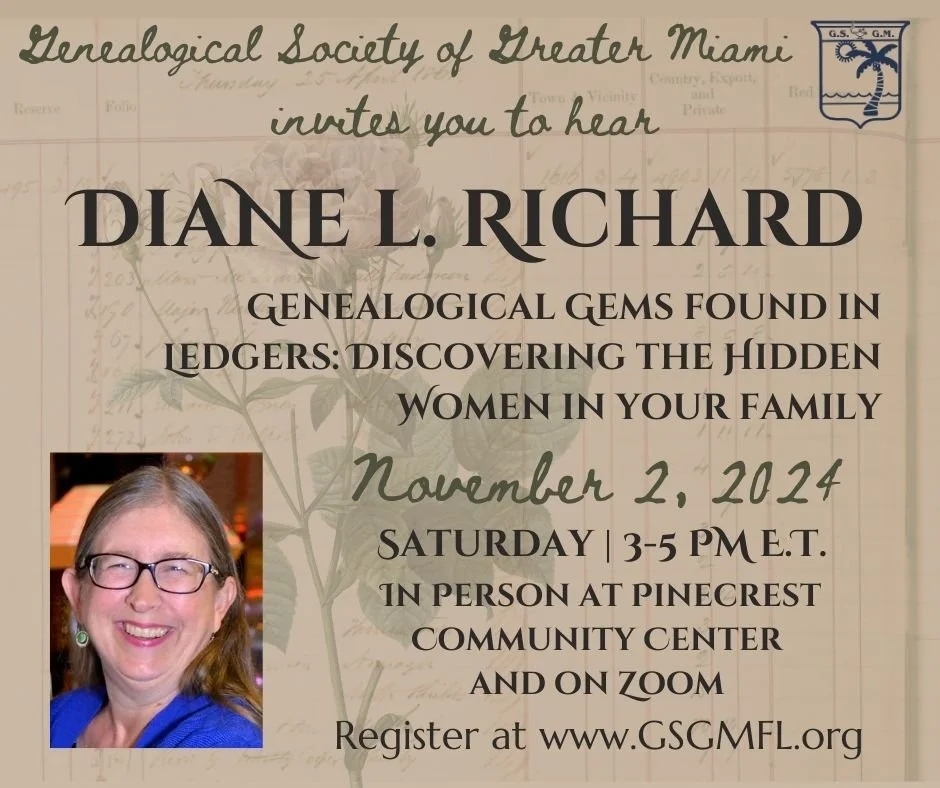
Discover strategies to use under-utilized resources such as manuscript collections and business ledgers to find women, who may otherwise be difficult to locate in historical records.
-
![]()
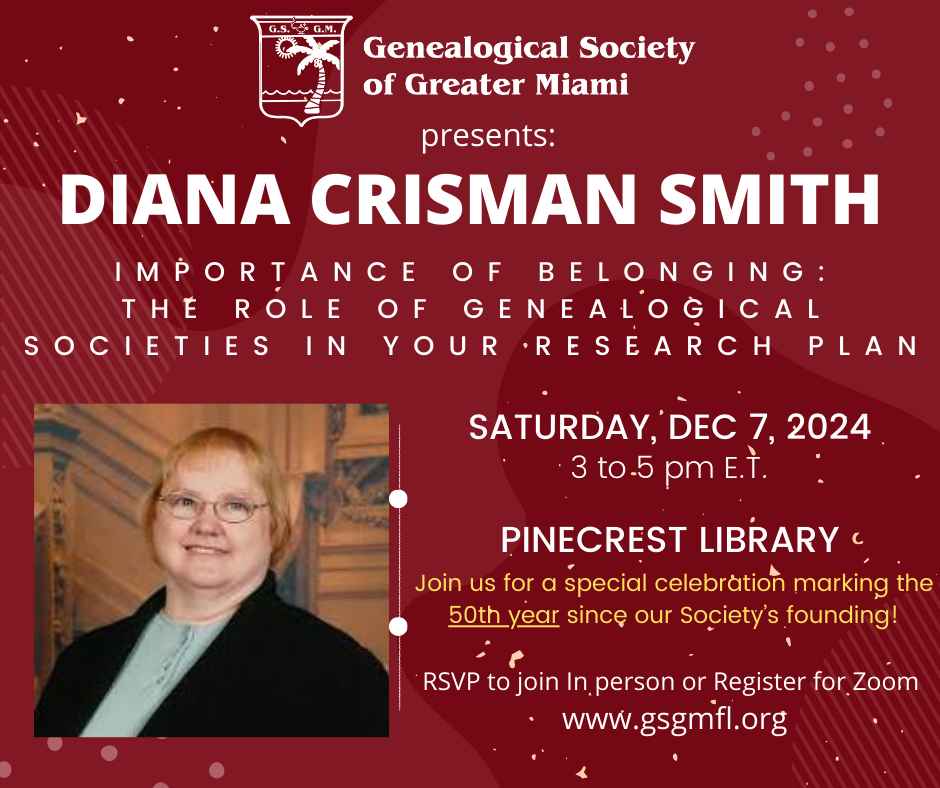
There are hundreds of genealogical societies around the world, each with a different focus and purpose. Somewhere there is at least one society which can assist in your research or technique development. Learn to analyze your needs and search out an appropriate organization. Then participate, which can aid in your personal growth and development.
-
![]()
Join us to hear David McCorkle, and learn how to use AI tools to process genealogical evidence from various records in a more comprehensive and less time consuming manner. This webinar will cover document analysis, reading handwriting, processing images, and more, using real examples and the latest tools.
-
![]()
Traveling in your ancestors’ footsteps holds a unique adventure for everyone. Whether you’ve traced your relatives back hundreds of years or you’re an adoptee who’s taken a DNA test, heritage travel is scalable to all budgets and locations. This presentation provides ideas for consideration, trusted suppliers, and tips to make the planning process smoother.
-
![]()
“Familienforschung: Insights for German Genealogy Websites.” In this session, Fritz Juengling showed us how to use some of the main sites for German research: Meyersgaz, FamilySearch, Ancestry, Archion, and Matricula, using case studies to find individuals.
-
![]()
You may be working to protect your research, photographs, and original documents from high humidity, hurricanes, power surges, and wayward movers, but what about for the next generation? In this engaging session, we'll explore the often-overlooked but deeply meaningful task of incorporating genealogical assets—such as family trees, heirlooms, photographs, DNA results, and historical documents—into your estate planning.
-
![]()
A meeting focused on getting started with genealogy, learning how to write a clear research question, and using it to build an effective research plan for conducting efficient research.
-
![]()
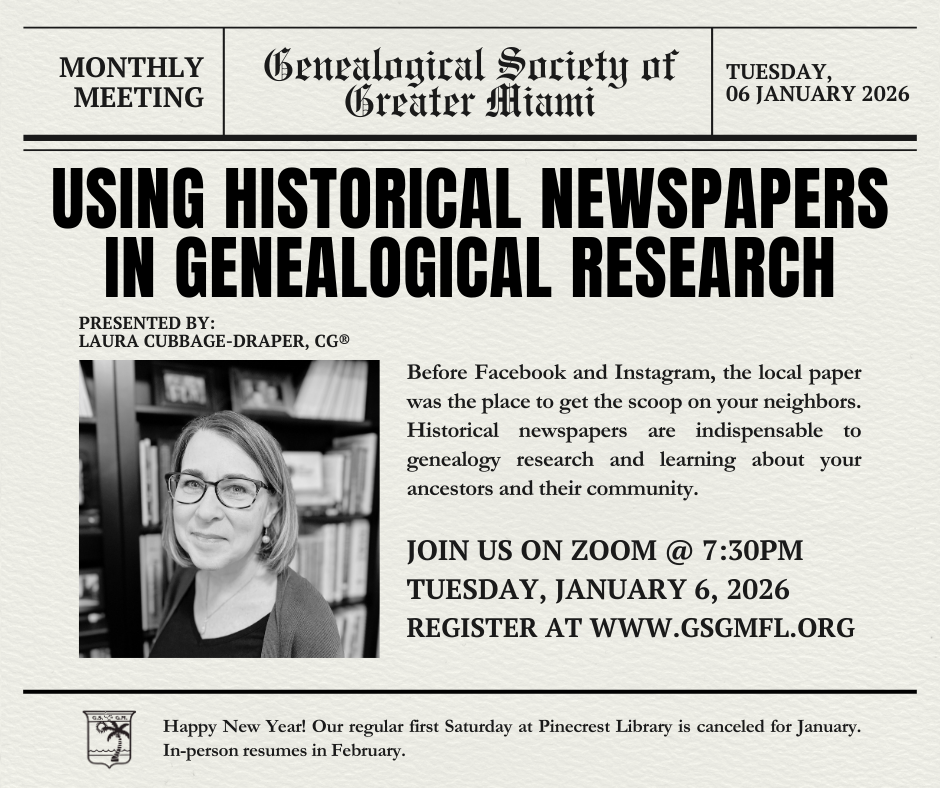
Historical newspapers are indispensable to genealogy research and learning about your ancestors and their community. This program highlighted the importance of this resource as well as the range of details that can be discovered, including how and where to access digitized US newspapers, plus search techniques and tips.
-
![]()
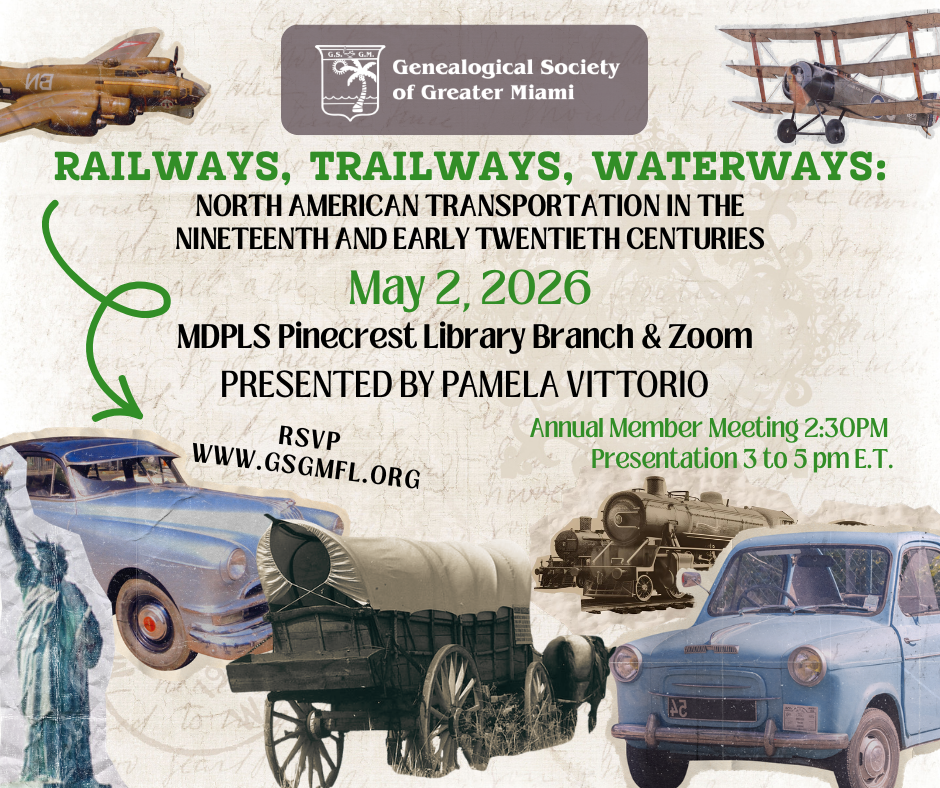
By studying the transportation networks our ancestors used— land, river, canal, lake, or sea—we can often narrow a place of origin, identify possible ports of departure and arrival, and better understand the realities of migration in North America.